
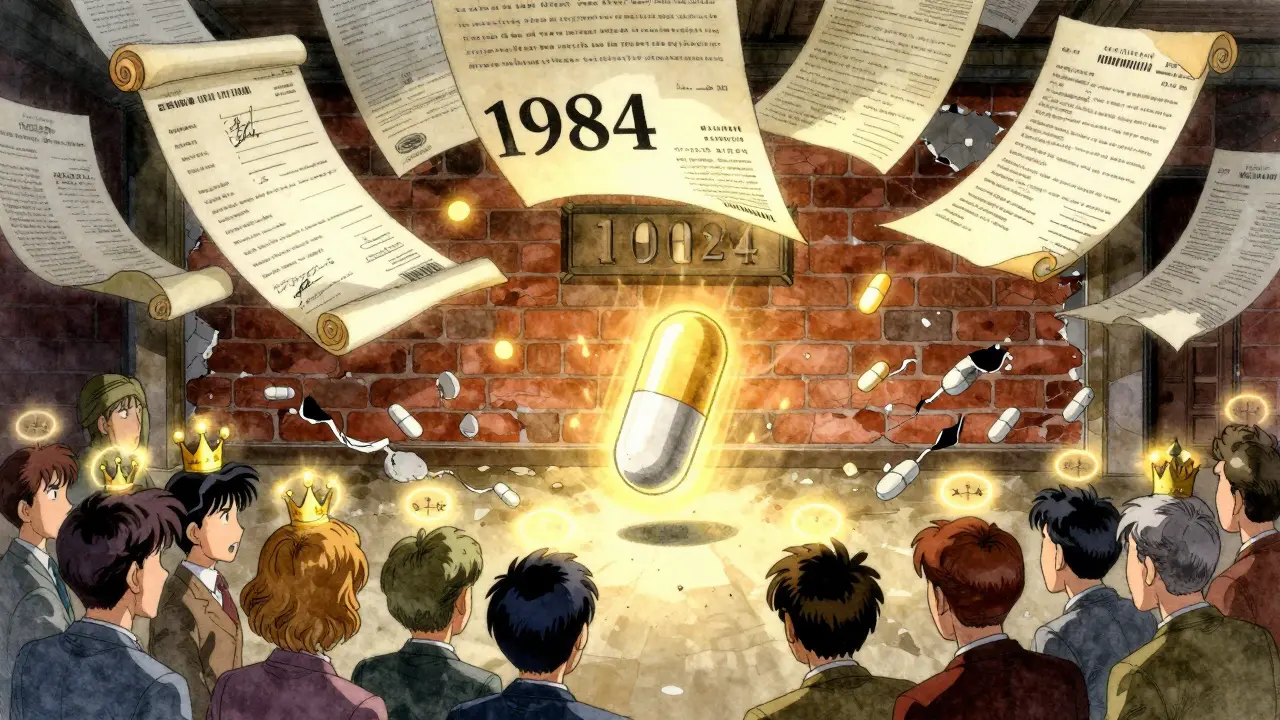
The Hatch-Waxman Act changed everything about how generic drugs reach American patients. Before 1984, bringing a generic version of a brand-name drug to market was nearly impossible. Generic manufacturers had to run their own full clinical trials-even though the original drug had already been proven safe and effective. That meant years of delays and millions in costs. Most couldn’t afford it. As a result, only a handful of generics existed. Patients paid more. The system was broken.
What the Hatch-Waxman Act Actually Did
The Drug Price Competition and Patent Term Restoration Act of 1984, better known as the Hatch-Waxman Act, fixed that. It created a new legal pathway called the Abbreviated New Drug Application, or ANDA. Instead of repeating expensive clinical trials, generic companies could now prove their drug was the same as the brand-name version-just cheaper. All they had to show was pharmaceutical equivalence and bioequivalence.
Pharmaceutical equivalence means the generic has the same active ingredient, strength, dosage form, and route of administration. Bioequivalence means it gets absorbed into the body at the same rate and amount. The FDA requires that the generic’s blood concentration (measured by AUC and Cmax) falls within 80% to 125% of the brand-name drug. That’s it. No new safety trials. No new efficacy studies. Just science, not bureaucracy.
The Orange Book: The Rulebook for Generic Entry
To make this work, the Act created the Approved Drug Products with Therapeutic Equivalence Evaluations-better known as the Orange Book. This isn’t just a list. It’s the legal map that tells generic companies when they can enter the market. Every brand-name drug sponsor must list every patent related to their drug in the Orange Book. That includes patents on the active ingredient, formulation, and even how it’s used.
When a generic company files an ANDA, they must certify against each listed patent. There are four types of certifications:
- Paragraph I: No patents listed.
- Paragraph II: Patents have expired.
- Paragraph III: We’ll wait until the patent expires.
- Paragraph IV: This patent is invalid or we won’t infringe it.
Paragraph IV is the game-changer. It’s the legal shot across the bow. By filing a Paragraph IV certification, a generic company is basically saying, “We’re challenging your patent.” That triggers a 45-day window for the brand-name company to sue for infringement. If they do, the FDA is legally required to delay approval for up to 30 months. That’s called the 30-month stay.
The 180-Day Exclusivity Prize
But here’s the twist: if you’re the first company to file a Paragraph IV certification and you win the lawsuit-or the brand drops it-you get 180 days of exclusive market access. No other generic can enter during that time. That’s a massive financial incentive. One generic company can capture 80% of the market in those six months. Prices drop fast. That’s why companies used to camp outside FDA offices in the 1990s, waiting to be first to submit.
The FDA changed the rules in 2003 to prevent cheating. If two companies file on the same day, they share the 180-day exclusivity. That stopped the “race to the mailbox” and made the system fairer. But it didn’t stop the drama. About 90% of Paragraph IV filings lead to lawsuits. And many of those lawsuits take close to 31 months-right at the 30-month limit. That means the brand-name drug stays protected longer than its patent says it should.

Patent Extensions and the “Evergreening” Problem
The Hatch-Waxman Act also lets brand-name companies extend their patent terms to make up for time lost during FDA review. They can get up to five extra years of exclusivity, but the total market life can’t exceed 14 years from the original approval date. That sounds fair-until you see how it’s used.
Some companies file dozens of secondary patents: on packaging, on dosing schedules, on minor chemical tweaks. These aren’t new inventions-they’re legal tricks to keep generics out. This is called “evergreening.” It’s not illegal, but it’s controversial. The FDA estimates that the average drug has 1.5 patents listed when it launches, but by the time generics enter, that number jumps to 3.5. Some drugs have over 10.
When a generic company tries to challenge one of these patents, the brand often counters with another. The process drags on. That’s why some generics still can’t enter even after the original patent expires. The system was designed to reward innovation, not delay competition.
Pay-for-Delay: When Brands and Generics Team Up
There’s another shady tactic: “pay-for-delay.” Sometimes, a brand-name company pays a generic manufacturer to delay its entry. Instead of fighting in court, they sign a deal: “We’ll give you millions, and you won’t sell your generic until next year.” The FTC has called these agreements anti-competitive. Courts have ruled some are illegal, but many still slip through. In 2023, the FTC sued three major pharmaceutical companies over pay-for-delay deals involving drugs used for high blood pressure and depression.
These deals cost consumers billions. The Congressional Budget Office estimates that ending pay-for-delay agreements could save the U.S. healthcare system $1.2 billion over ten years.
The Real Impact: Generics Are Everywhere Now
Before Hatch-Waxman, only 19% of prescriptions filled in the U.S. were generics. Today, it’s over 90%. But here’s the kicker: generics make up just 23% of total drug spending. That’s because they’re so cheap. The average generic drug costs 80% to 90% less than the brand-name version.
Over the past decade, generic drugs have saved the U.S. healthcare system $1.7 trillion. That’s $158 billion a year. For Medicare Part D beneficiaries, that translates to an average savings of $3,200 per person annually. Without Hatch-Waxman, those numbers wouldn’t exist.
The generic industry is now a $70 billion business in the U.S. with over 11,000 approved products. In fiscal year 2023 alone, the FDA approved 746 ANDAs. That’s up from just 150 in 2000. The average review time has dropped from 36 months to 18 months thanks to user fee programs like GDUFA.

Where the System Still Falls Short
But it’s not perfect. In 2023, 283 generic drugs were in short supply. Many of them were old, low-margin drugs made by just one or two factories. If one plant shuts down-because of quality issues, a fire, or a regulatory shutdown-there’s no backup. That’s why the FDA now requires companies to report manufacturing changes in real time.
Also, Hatch-Waxman was built for small-molecule drugs. It doesn’t work well for complex biologics-like insulin, rheumatoid arthritis drugs, or cancer treatments. That’s why Congress passed the Biologics Price Competition and Innovation Act (BPCIA) in 2010. It created a separate pathway for biosimilars, but it’s slower and more complicated. Biosimilars still make up less than 5% of the biologic market.
Another issue: brand-name companies sometimes refuse to give generic makers the samples they need to test bioequivalence. That’s illegal under the CREATES Act of 2019, but enforcement is patchy. The FDA has started fining companies that block access to samples, but it’s still happening.
What’s Next for Generic Drugs?
The FDA is working on new guidance for complex generics-like inhalers, injectables, and topical creams. These aren’t simple pills. They’re hard to copy. The agency is also pushing for more transparency in patent listings and faster resolution of patent disputes.
Congress is debating whether to limit patent term extensions and crack down harder on pay-for-delay. Some lawmakers want to force brand companies to disclose all their patents upfront. Others want to shorten the 30-month stay.
One thing’s clear: the Hatch-Waxman Act isn’t going away. It’s the backbone of U.S. drug policy. But it’s being stretched thin. As more complex drugs come off patent, the system will need updates. The goal hasn’t changed: make safe, effective drugs affordable. The challenge now is making sure the rules keep up with the science.
What is the Hatch-Waxman Act?
The Hatch-Waxman Act, passed in 1984, is a U.S. federal law that created a streamlined pathway for generic drug approval through the Abbreviated New Drug Application (ANDA). It balances innovation by protecting brand-name drug patents while enabling faster, cheaper generic entry by allowing generic manufacturers to rely on the brand’s safety and efficacy data.
How do generic drugs get approved under Hatch-Waxman?
Generic manufacturers file an ANDA with the FDA, proving their drug is pharmaceutically and bioequivalent to the brand-name Reference Listed Drug (RLD). They don’t repeat clinical trials. Instead, they show their drug delivers the same amount of active ingredient into the bloodstream at the same rate, with blood concentration levels falling within 80-125% of the brand’s.
What is the Orange Book?
The Orange Book is the FDA’s official list of approved drug products with therapeutic equivalence ratings. Brand-name manufacturers must list all patents related to their drug in the Orange Book. Generic companies use this list to determine when they can legally enter the market and which patents to challenge.
What is a Paragraph IV certification?
A Paragraph IV certification is a legal statement by a generic drug applicant claiming that a brand-name drug’s patent is invalid or won’t be infringed. Filing this triggers a patent lawsuit from the brand company and can lead to a 30-month delay in FDA approval. But if the generic wins, they get 180 days of market exclusivity.
Why do generic drugs cost so much less than brand-name drugs?
Generic drugs cost less because they don’t have to repeat expensive clinical trials. The Hatch-Waxman Act lets them rely on the brand’s safety and efficacy data. Development costs dropped from $2.6 million in 1984 to $5-10 million today-still far less than the $1-2 billion it takes to develop a new brand drug.
Can the Hatch-Waxman Act be used for biologics?
No. The Hatch-Waxman Act was designed for small-molecule drugs. Biologics-like insulin, monoclonal antibodies, and vaccines-are too complex to copy exactly. Congress created the Biologics Price Competition and Innovation Act (BPCIA) in 2010 to establish a separate pathway for biosimilars, which have different requirements and longer approval timelines.
What You Should Know
If you’re taking a generic drug, you’re benefiting from the Hatch-Waxman Act. It’s why your $4 prescription at the pharmacy exists. But behind that simple pill is a decades-old legal battle between innovation and access. The system works-but only if it’s enforced fairly. When patents are abused, when deals are made in secret, when samples are blocked-it’s patients who pay the price.
The next time you refill a generic, remember: it’s not just chemistry. It’s law. And that law is still being shaped-today, tomorrow, and for years to come.