

Every year, more than 1.5 million people in the U.S. are harmed by medication errors - and nearly all of them are preventable. Many of these errors happen because someone didn’t double-check the medication name, the strength, or the dosage form. It sounds simple, but in the rush of a busy hospital shift, a crowded pharmacy, or even at home when managing multiple prescriptions, these details get missed. And the consequences? A patient gets 10 times the right dose. A pill meant for the skin is swallowed. A drug meant for diabetes is confused with one for high blood pressure. These aren’t hypotheticals. They happen every day.
Why Checking Medication Details Isn’t Optional
Medication errors aren’t just about human mistakes. They’re often caused by systems that let details slip through. Look-alike, sound-alike drug names - like prednisone and prednisolone - are easy to mix up. Strengths written without spaces - like “10mg” instead of “10 mg” - can be misread as “100 mg.” Dosage forms matter too: a tablet you swallow is not the same as a liquid you inject. One wrong move can be deadly.
The Institute of Medicine found that medication errors cause at least 7,000 deaths each year in U.S. hospitals. The Agency for Healthcare Research and Quality (AHRQ) says most of these happen because the person giving the drug didn’t verify the name, strength, or form against the original order. The FDA, ISMP, and other safety groups have spent decades building rules to stop this - and they all agree: verification is non-negotiable.
The Three Things You Must Check Every Time
Before you give, dispense, or take any medication, ask yourself these three questions:
- Is the drug name written clearly and completely? No abbreviations. No shorthand. “MS” could mean morphine sulfate or magnesium sulfate - and those are completely different drugs. Use full names: “Morphine Sulfate,” not “MS.” Avoid “U” for units - write “units” instead. “U” looks like “0” or “4” on bad printouts or handwritten notes. That’s how people get 10 times too much insulin.
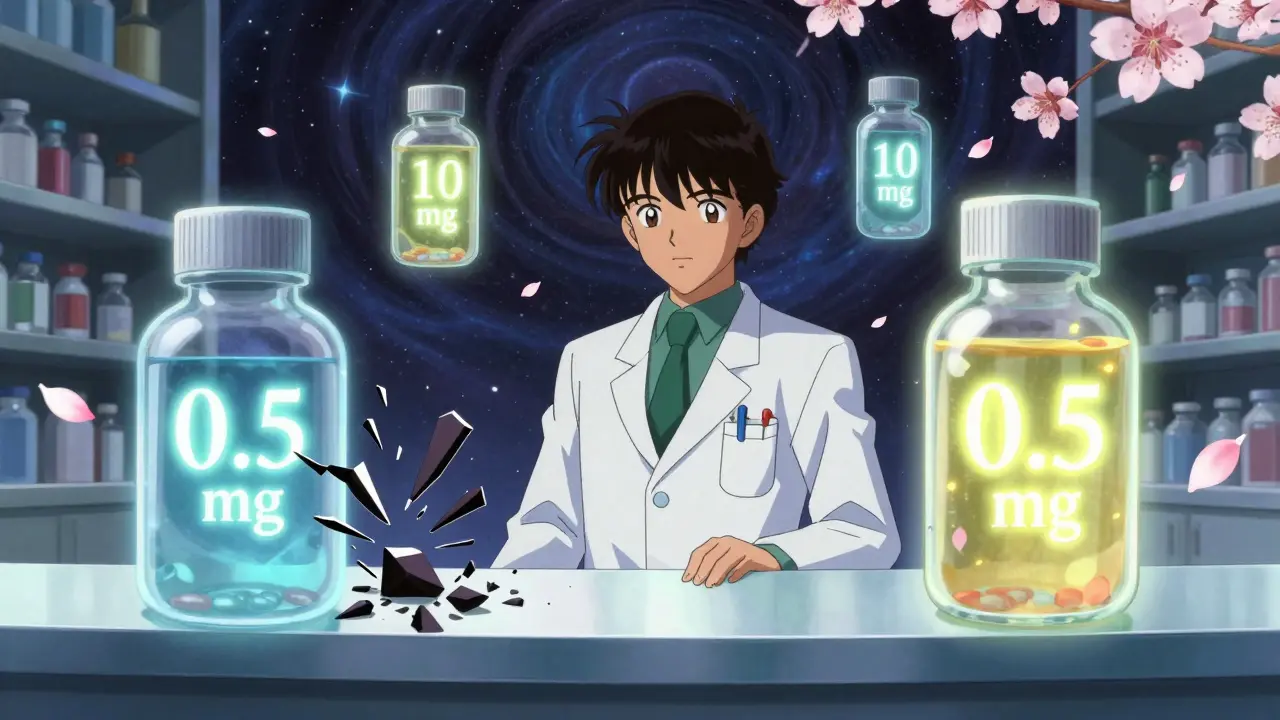
- Is the strength correct and properly formatted? Strength tells you how much of the drug is in each unit. A 500 mg tablet is not the same as a 50 mg tablet. Always check the number and the unit. Is it mg, mcg, mL, or units? Write it with a space: “500 mg,” not “500mg.” Use a leading zero: “0.5 mg,” not “.5 mg.” Never write “5.0” - that could be misread as “50.” For injectables, avoid ratios. “Epinephrine 1:10,000” should be written as “0.1 mg/mL.” That’s the standard now, because people kept giving the wrong concentration.
- Is the dosage form right for how it’s supposed to be used? Is this a pill, liquid, patch, inhaler, or injection? Oral tablets are not meant to be crushed and mixed into food unless the label says so. Topical creams shouldn’t be swallowed. IV solutions shouldn’t be given by mouth. A 2023 Reddit thread from pharmacists listed 147 real cases where dosage form confusion led to harm. One nurse saved a patient when she noticed the order said “Heparin 5,000 units/mL” but the vial said “50 units/mL.” She didn’t assume - she checked.
How to Verify Like a Pro
Verification isn’t a one-time check. It’s a process that happens at three key moments:
- When you receive the order - whether it’s from a doctor, an e-prescription, or a family member. Look for missing info. Is the strength there? The form? The route? If it’s incomplete, don’t proceed. Call the prescriber. Ask for clarification. It’s better to delay than to risk harm.
- When you prepare the medication - whether you’re pulling a bottle from the shelf, counting pills, or drawing up a syringe. Compare the label on the container to the order. Use the “five rights”: right patient, right drug, right dose, right route, right time. If you’re using a barcode scanner, scan it. Don’t skip it just because you’re in a hurry. Studies show barcode scanning cuts dispensing errors by 83%.
- When you give the medication - right before it goes to the patient. Say it out loud: “This is Metformin 500 mg tablet, taken by mouth once daily.” Use the “read-back” method. Ask the patient to repeat it back if they’re alert. This catches 89% of errors, according to the American Nurses Association.
What Tools Help You Get It Right
Technology isn’t perfect, but it helps - if used right.
- EHR systems with clinical decision support - like Epic or Cerner - flag look-alike names and mismatched strengths. A 2022 study found these systems reduce errors by 55%. But don’t trust them blindly. Some clinicians ignore alerts because they’re overwhelmed. That’s called “alert fatigue.” Always verify the system’s warning with your own eyes.
- Tall Man lettering - this is when similar drug names use capital letters to highlight differences. For example: predniSONE and predniSOLONE. The FDA and ISMP recommend this. It reduces confusion by 76%.
- RxNorm - this is the standardized drug naming system used by most U.S. pharmacies and hospitals. If your system uses RxNorm, you’re more likely to get the right drug. Always check that the name matches RxNorm’s official entry.
- Barcode scanning - used in 92% of U.S. hospitals. It links the patient’s wristband to the medication. If the barcode doesn’t match, the system stops you. It’s one of the most effective tools we have.
Common Mistakes - And How to Avoid Them
Here are the top five errors people make - and how to stop them:
- Using abbreviations - “U” for units, “mcg” written as “μg,” “q.d.” for daily. These are banned for good reason. Always write “units,” “mcg,” and “daily.”
- Missing decimal points - “.5 mg” instead of “0.5 mg.” That missing zero can mean a 10-fold overdose. Always use leading zeros.
- Not checking the vial or bottle - You see “Lisinopril 10 mg” on the screen, but the bottle says “Lisinopril 20 mg.” Don’t assume. Look at the physical container every time.
- Assuming the form is right - “Is this a pill or a liquid?” If the order doesn’t say, ask. A patch meant for skin applied to the eye? That’s a serious error.
- Skipping verification under pressure - 78% of nurses admit they’ve skipped a step because they were rushed. Don’t be one of them. Slowing down for 10 seconds saves lives.

What You Can Do at Home
You don’t have to be a nurse or pharmacist to verify medications safely. If you’re managing prescriptions for yourself or someone else:
- Keep a written list of all your meds: name, strength, form, and how often to take them.
- When you get a new prescription, compare the label on the bottle to your list. Does the strength match? Is the form right?
- Ask the pharmacist: “Is this a tablet or a capsule? Is it 5 mg or 50 mg?”
- Use a pill organizer - but only if you’ve confirmed the correct medication and dose first.
- If something looks wrong - the color, size, or shape of the pill - call the pharmacy. Don’t take it.
The Future of Medication Safety
AI is starting to help. Google Health tested a system in 2023 that used computer vision to read medication labels and spot mismatches - it was 99.2% accurate. But the FDA hasn’t approved it for use yet. The real progress is in policy. States with mandatory verification rules have 29% fewer errors. Hospitals that use a “four-eyes” rule - two people check high-risk drugs - cut errors by 94%. These aren’t futuristic ideas. They’re working now.
The message is clear: verifying medication names, strengths, and dosage forms isn’t a task. It’s a lifeline. Every time you check, you’re not just following a rule - you’re stopping a mistake before it happens.
Why is it dangerous to write '10mg' without a space?
Writing '10mg' without a space can be misread as '100 mg' - especially on handwritten notes or low-quality printouts. The Institute for Safe Medication Practices found that adding a space between the number and unit ('10 mg') prevents about 12% of medication errors related to unit confusion. This small change makes it harder to misinterpret the dose.
What should I do if a medication looks different than usual?
Never assume it’s just a different brand or generic version. Check the name, strength, and dosage form on the label against your prescription. If anything doesn’t match - color, shape, size, markings - call your pharmacy. A change in appearance could mean you got the wrong drug. This is one of the most common ways people get harmed by medication errors.
Can I trust the electronic prescription system to catch all mistakes?
No. While electronic systems flag many errors - like look-alike names or incorrect strengths - they don’t catch everything. Studies show that 18% of errors happen because clinicians ignore alerts due to alert fatigue. Always verify the system’s output against the original order and the physical medication. Technology is a tool, not a replacement for human attention.
What’s the difference between strength and dosage form?
Strength tells you how much drug is in each unit - like 5 mg, 10 mL, or 500 units. Dosage form tells you what kind of medication it is - tablet, capsule, liquid, patch, injection. A 10 mg tablet and a 10 mg liquid have the same strength but different forms. Giving a tablet when a liquid is prescribed can be dangerous - especially for people who can’t swallow pills.
Why is 'MS' a dangerous abbreviation?
'MS' can mean either morphine sulfate (a powerful painkiller) or magnesium sulfate (used for seizures and pre-eclampsia). These drugs do completely different things. Confusing them can lead to overdose or missed treatment. That’s why medical guidelines ban all ambiguous abbreviations - always write out the full name.


