

When you pick up a prescription, you might not think twice when the pharmacist hands you a different pill than what the doctor wrote on the script. But here’s the truth: you have the legal right to refuse a generic drug and ask for the brand-name version instead. And in many states, the pharmacist can’t swap it out without your permission.
Generic drugs are cheaper. That’s why pharmacies and insurance companies push them. But cheaper doesn’t always mean safer-especially if you’re on a drug with a narrow therapeutic index, like levothyroxine, warfarin, or certain epilepsy medications. A small change in how the drug is absorbed can throw your whole treatment off. And if you’ve been stable on a brand-name drug for years, switching without warning can be dangerous.
What Is Generic Substitution, Really?
Generic substitution means a pharmacist replaces the brand-name drug your doctor prescribed with a generic version that contains the same active ingredient. It’s legal, common, and usually safe. The FDA says these drugs are therapeutically equivalent-meaning they should work the same way. But equivalence doesn’t mean identity. Generics can have different fillers, coatings, or manufacturing processes. For most people, that’s fine. For others, it’s a problem.
Think of it like this: two cars might both be labeled "Sedan" and have the same engine. But one has a better suspension, quieter tires, and a more reliable transmission. If you’ve been driving the better one for years and suddenly get the cheaper version, you might notice a difference-even if both are "legal".
Your Legal Rights: It Varies by State
There’s no single federal law that controls this. Instead, each state has its own rules. And they’re wildly different.
- In 19 states-including California, Texas, and Florida-pharmacists can automatically substitute generics unless the doctor says "do not substitute." You have no legal say unless you speak up.
- In 7 states plus Washington, D.C.-like Massachusetts, Vermont, and Hawaii-you must give explicit consent before a substitution happens. The pharmacist can’t switch your drug without asking you first.
- In 31 states plus D.C., the pharmacist must notify you that a substitution is happening. That means they have to tell you out loud or in writing. But they still might swap it unless you say no.
So if you live in New York, you might get a generic without knowing. If you live in Maine, they have to ask you. And if you live in Hawaii, they can’t substitute antiepileptic drugs at all without both your doctor’s and your approval.
How to Say No-And Make It Stick
You don’t need a PhD to protect yourself. Here’s how to do it:
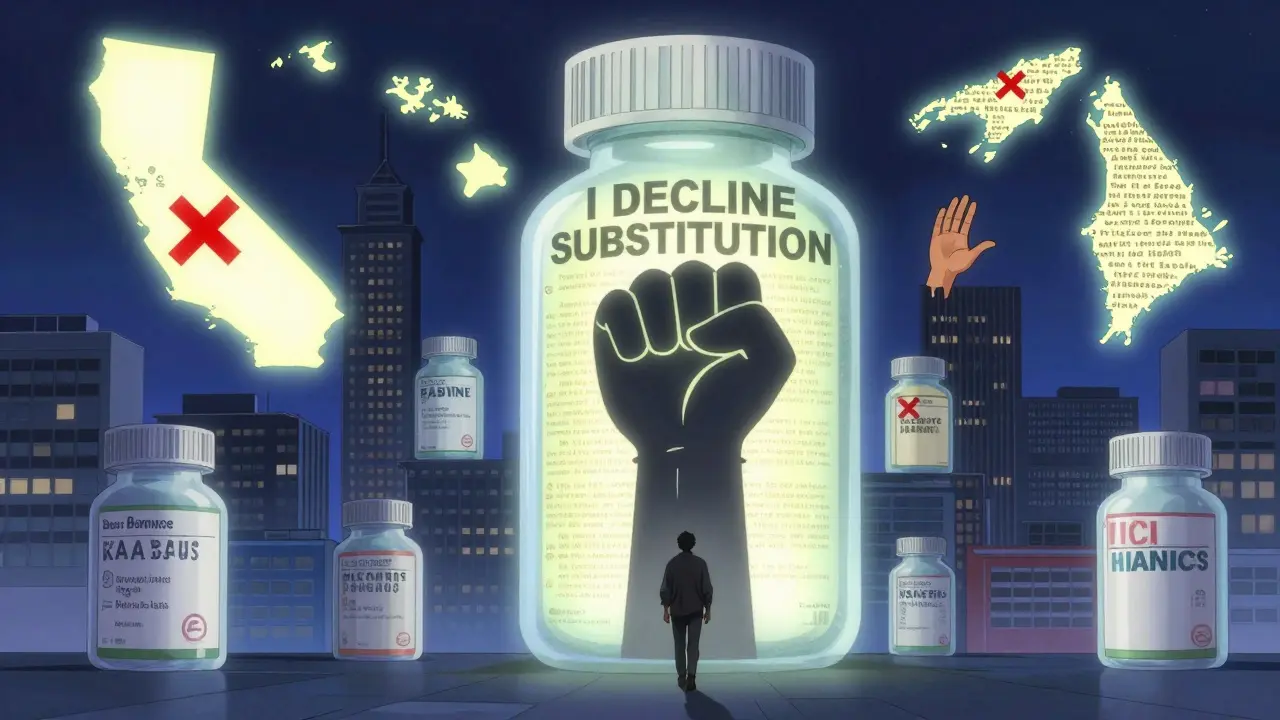
- At the counter, say clearly: "I decline substitution. I want the brand-name drug." That’s it. In 43 states, those exact words are legally enough to stop the swap. You don’t need to explain why. You don’t need to show a note. Just say it.
- Ask for a "dispense as written" note from your doctor. If you’ve had bad reactions to generics before-or if you’re on a high-risk drug like insulin or seizure meds-ask your doctor to write "brand medically necessary" or "do not substitute" on the prescription. Forty-eight states recognize this as a legal exemption.
- If the pharmacist pushes back, ask for the manager. Many pharmacists don’t know the law. They’ve been told by their pharmacy chain to substitute whenever possible. But if you calmly say, "I’m exercising my right under [your state] law," most managers will back down. Keep your tone polite but firm.
One patient in Massachusetts told her pharmacist, "I decline substitution per state law," and walked out with her brand-name Synthroid-no extra cost, no hassle. Another in Florida refused a generic for his blood thinner and later found out his insurance would’ve paid the same price if he’d just asked.

When Brand-Name Drugs Are Non-Negotiable
Some drugs are too sensitive to risk swapping. The FDA calls these "narrow therapeutic index" (NTI) drugs. That means the difference between a safe dose and a harmful one is tiny. Examples include:
- Levothyroxine (for thyroid disease)
- Warfarin (blood thinner)
- Phenytoin, carbamazepine (for seizures)
- Cyclosporine (for organ transplants)
- Some insulin products
For these, even small changes in how the drug is absorbed can lead to serious side effects-seizures, strokes, or dangerous blood clots. A 2019 lawsuit in Michigan followed a patient who had a seizure after an automatic switch to a generic antiepileptic drug. The pharmacy was found liable.
And it’s not just generics. Biosimilars-like the newer versions of insulin or rheumatoid arthritis drugs-are not the same as generics. They’re complex biological products. The World Medical Association says they shouldn’t be swapped without your doctor’s knowledge. Yet many pharmacies still do it automatically.
What to Do If You’re Switched Without Consent
Did your pharmacy switch your drug without telling you? Did you notice changes in how you feel-mood swings, weird side effects, unstable blood sugar? Here’s what to do:
- Call your doctor. Tell them exactly what happened. They may need to write a new prescription with "do not substitute" or switch you to a different drug.
- Contact your state pharmacy board. All 50 states have a board that handles complaints. You can file online. No lawyer needed. They investigate and can fine pharmacies that break the law.
- Report to the FDA. Use the MedWatch system to report adverse events. Even if you’re not sure it was the drug, it helps build a case.
- Keep records. Save your receipts. Write down the date, name of the drug, and what happened. If you need to escalate later, this matters.
A 2021 Consumer Reports survey found 28% of people who tried to refuse substitution ran into pushback. Some pharmacists claimed they "had to" substitute. That’s illegal in states requiring consent. Others said refusing would cost more. But thanks to the 2018 Know the Lowest Price Act, pharmacists now must tell you if paying cash is cheaper than using insurance. Ask: "What’s the cash price?"
Costs and Savings: What You Really Pay
Generics cost 80-85% less than brand-name drugs. On average, you save $27.50 per prescription. That’s real money. But here’s the catch: if you’re one of the 12% of patients who have a bad reaction to a generic, the cost skyrockets. You might need emergency care, extra lab tests, or a new prescription. A 2022 Congressional Budget Office report found non-medical switching (changing stable patients just to save money) costs the system $2.1 billion a year.
Insurance doesn’t always save you. Sometimes, your co-pay for a brand-name drug is the same as the generic-especially if you’re on Medicare Part D. Ask your pharmacist: "Is the cash price lower?" You might be surprised.
What’s Changing Now?
In 2023, Colorado and Nevada passed new laws requiring pharmacists to notify doctors when they switch a patient’s biosimilar. That’s a big step. Now 47 states have some form of protection for biologic drugs.
The FDA is also updating its guidelines. They’re starting to treat complex drugs-like inhalers, creams, and injectables-differently. Some won’t be interchangeable at all. That’s good news for patients who need stability.
But drug shortages are making things harder. If a generic is out of stock, pharmacies might substitute with a different brand. Or they might delay your fill. Stay informed. Check the FDA’s drug shortage list if you’re on a critical medication.
Final Advice: Know Your State, Speak Up
You don’t need to fight a battle every time you refill a prescription. But if you’re on a high-risk drug-or if you’ve had problems with generics before-know your rights. Find your state’s pharmacy board website. Look up their generic substitution law. Print it. Keep it in your wallet.
Most pharmacists want to help. They just don’t always know the law. Your job isn’t to argue. It’s to be clear, calm, and consistent. Say: "I decline substitution." Then walk away. You’ve done your part.
And if you’re ever unsure? Call your doctor. Ask your pharmacist: "What does my state law say?" The answer might surprise you-and it might save your health.
Can a pharmacist refuse to give me the brand-name drug if I ask for it?
No. If you ask for the brand-name drug and it’s legally available, the pharmacist must fill that request. In states that require consent, they can’t substitute without your permission. In states that allow automatic substitution, they still must honor your refusal. If they refuse to fill your prescription, they’re breaking the law. Ask for the manager and mention your state’s pharmacy board.
Do I have to pay more if I refuse a generic?
Not necessarily. Many insurance plans have the same co-pay for brand-name and generic drugs, especially for high-risk medications. Even if the brand is more expensive, your out-of-pocket cost might be identical. Always ask the pharmacist: "What’s the cash price?" Sometimes paying cash is cheaper than using insurance. The 2018 Know the Lowest Price Act requires them to tell you.
Can my doctor prevent substitution without my consent?
Yes. If your doctor writes "dispense as written" or "brand medically necessary" on your prescription, pharmacists are legally required to follow it. This works in 48 states. It’s especially important for NTI drugs like thyroid medication, blood thinners, or seizure drugs. Ask your doctor to add this note-it’s quick and protects you.
Are biosimilars the same as generics?
No. Biosimilars are not generic versions of biologic drugs. They’re similar, but not identical. They’re made from living cells, not chemicals, and can have subtle differences that affect how your body responds. The FDA allows substitution only if the drug is labeled as "interchangeable." But even then, many states require notification to your doctor. Always ask: "Is this a biosimilar?" and "Was I notified?"
What should I do if I think a substitution caused a bad reaction?
First, contact your doctor immediately. Then, file a report with your state pharmacy board and the FDA’s MedWatch system. Keep all your prescription receipts and notes about symptoms. If you had to go to the ER or had lab work done because of the switch, save those records. These steps help protect you and others. In 2019, a Michigan patient successfully sued a pharmacy after an automatic substitution led to a seizure.