
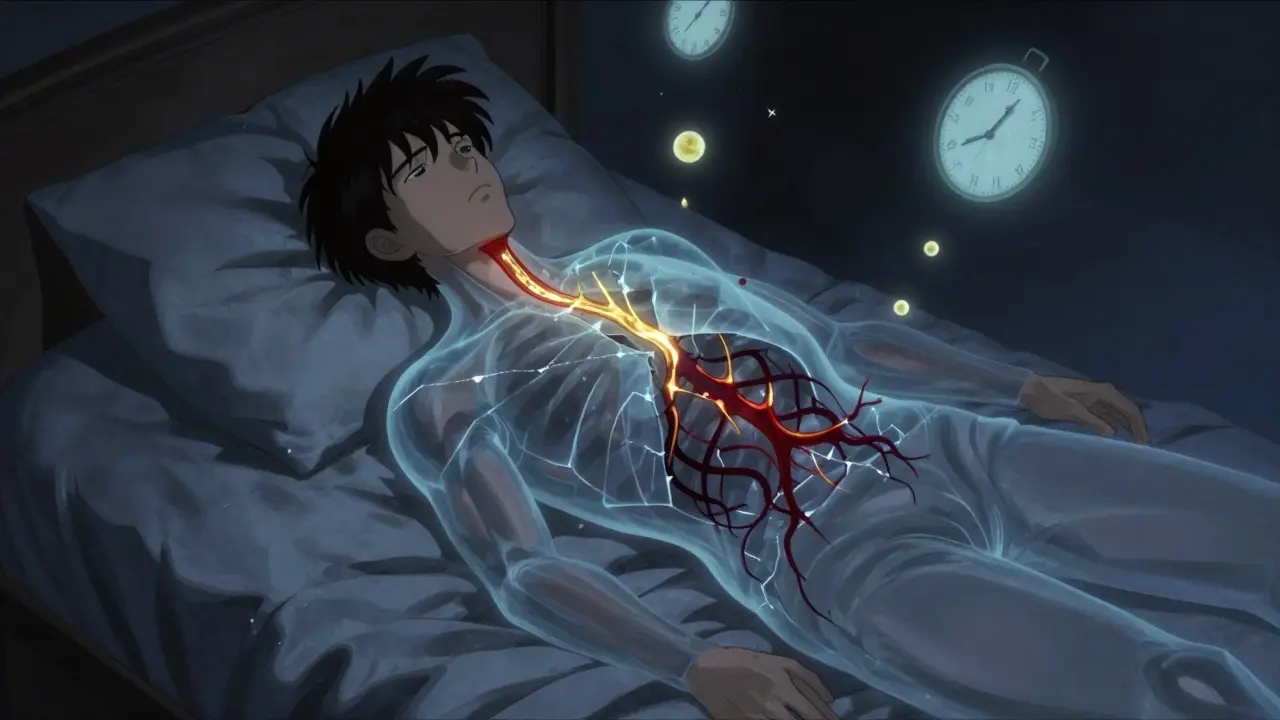
When Your Sleep Stops, Your Heart Strains
Imagine waking up gasping for air, your heart pounding, your body drenched in sweat-even though you didn’t move all night. If this sounds familiar, you might have sleep apnea. It’s not just snoring. It’s a silent killer that’s quietly raising your blood pressure and putting your heart at serious risk. About 1 billion people worldwide have it, and in the U.S. alone, 40 million adults are affected. Yet, 80% of those with moderate to severe sleep apnea don’t even know they have it.
This isn’t just about feeling tired. Sleep apnea is a direct threat to your heart. Every time your airway collapses during sleep-hundreds of times a night-your body goes into survival mode. Oxygen drops. Stress hormones spike. Blood pressure surges. Over time, this pattern rewires your cardiovascular system. The result? Higher chances of heart attack, stroke, heart failure, and irregular heart rhythms. And the worst part? Doctors often miss it.
How Sleep Apnea Breaks Down Your Blood Pressure
Your blood pressure doesn’t stay the same all day. Normally, it dips 10% or more at night while you sleep. That’s called “dipping.” It’s your body’s way of resting your heart. But if you have sleep apnea, that dip vanishes. In fact, 70-80% of people with moderate to severe sleep apnea don’t dip at all. Some even see their blood pressure rise at night-a pattern called “reverse dipping.”
This isn’t random. Every time your breathing stops, your brain panics. It sends signals to your nervous system to wake you up-just enough to restart breathing, but not enough for you to remember it. In that split second, your body releases adrenaline and other stress chemicals. Your heart races. Your blood vessels tighten. Your blood pressure spikes-sometimes by 30-40 mmHg in a single episode.
Repeat that 30, 50, or even 100 times a night, every night, and your blood pressure never gets a real break. Over months and years, your body starts treating this high-pressure state as normal. That’s how you end up with chronic high blood pressure-even if you eat well, exercise, and take medication. In fact, up to 80% of people with resistant hypertension (high blood pressure that won’t go down despite three different drugs) have undiagnosed sleep apnea.
The Heart Disease Connection: More Than Just a Coincidence
High blood pressure is just the start. Sleep apnea doesn’t just raise your numbers-it damages your heart at the cellular level.
When oxygen drops during an apnea episode, your cells go into stress mode. They produce more free radicals, which cause oxidative damage. Your blood vessels lose their ability to relax. Inflammation spikes-C-reactive protein levels rise by 35-50% in people with untreated sleep apnea. This is the same inflammation that clogs arteries and triggers heart attacks.
Studies show that people with moderate to severe sleep apnea have a 30% higher risk of coronary artery disease. They’re 1.6 times more likely to die from a heart attack. And here’s something chilling: nearly 27% of heart attacks in people with sleep apnea happen between midnight and 6 a.m.-when apnea episodes are most frequent. That’s double the rate seen in people without sleep apnea.
Heart failure is even more closely tied. Around 40-60% of heart failure patients also have sleep apnea. And if you have sleep apnea, your risk of developing heart failure jumps by 140%. The reason? The repeated pressure swings in your chest during apnea episodes force your heart to work harder-like running a marathon while holding your breath.
Arrhythmias and Stroke: The Hidden Dangers
Your heart’s rhythm is delicate. Sleep apnea throws it off balance. People with sleep apnea are 2 to 4 times more likely to develop atrial fibrillation (AFib)-a dangerous irregular heartbeat that can lead to stroke. In one study, nearly half of all patients with paroxysmal AFib had undiagnosed sleep apnea. And if you’ve had AFib and don’t treat your sleep apnea, your chance of it coming back after treatment like ablation drops by 30%.
Stroke risk is even more alarming. Sleep apnea doubles your chance of having a first stroke. If you’ve already had one, your risk of another jumps by more than three times. And the worse your oxygen levels drop during sleep, the deadlier the stroke. When oxygen saturation falls below 90% for more than 12% of your sleep time, your risk of dying from a stroke triples.
Why? Because when your brain doesn’t get enough oxygen, it triggers clotting, inflammation, and vessel damage-all of which make stroke more likely. And because these events often happen at night, they’re harder to catch early.
Why Younger People Are at Higher Risk
Most people think sleep apnea is an older adult problem. It’s not. A major 2024 study found that adults aged 20-40 with sleep apnea symptoms are 45% more likely to have high blood pressure, 33% more likely to have diabetes, and 25% more likely to have metabolic syndrome than their peers without symptoms.
In older adults, those same risks are much smaller-just 10-12% higher. That means sleep apnea isn’t just a symptom of aging. It’s an accelerator. In young people, it’s pushing cardiovascular disease forward by years, even decades. If you’re under 40 and have loud snoring, daytime fatigue, or unexplained high blood pressure, don’t wait. Get checked.
Why CPAP Isn’t Always Enough
Continuous Positive Airway Pressure (CPAP) is the standard treatment. It uses a mask and air pressure to keep your airway open. It works. But not as well as most people think.
CPAP only lowers blood pressure by 2-3 mmHg on average. That’s not enough to make a big difference for someone with severe hypertension. It doesn’t reverse years of damage. But here’s what it does do: it cuts stroke recurrence by 37%, improves heart failure outcomes, and makes heart rhythm treatments more effective.
The real problem? Adherence. Only 46% of people who start CPAP use it enough-4 hours a night, 70% of nights-to get real benefits. Many quit because the mask is uncomfortable, the machine is noisy, or they don’t feel better right away. But if you stop using it, your risks go right back up.
There are other options-oral appliances, weight loss, positional therapy, even surgery. But none work unless you’re diagnosed first.

What You Should Do Now
If you have any of these, you need to talk to your doctor:
- Loud, chronic snoring
- Waking up gasping or choking
- Daytime exhaustion even after 8 hours of sleep
- High blood pressure that won’t respond to medication
- Diagnosed with atrial fibrillation, heart failure, or stroke
- Obesity or waist size over 40 inches (men) or 35 inches (women)
Ask for a sleep screening. The STOP-Bang questionnaire-a simple 8-question tool-is used by cardiologists and has an 84% success rate in spotting moderate to severe sleep apnea. You can take it at home in under a minute.
Home sleep tests are now widely available and catch 85-90% of moderate to severe cases. If your doctor says it’s “just snoring,” push back. The American Heart Association says: “Consider sleep apnea in every patient with hypertension, AFib, stroke, or heart failure.”
And if you’ve been told you have sleep apnea but aren’t using your CPAP-start now. Even 2 hours a night is better than none. Use it consistently for a month. Track your energy, your blood pressure, your mood. You might be surprised.
It’s Not Just About Sleep-It’s About Survival
Sleep apnea is not a nuisance. It’s a cardiovascular emergency in slow motion. It doesn’t just steal your rest-it steals your life expectancy. The same forces that cause your breathing to stop at night are the same ones that clog your arteries, rupture your plaques, and trigger heart attacks.
And yet, it’s one of the most treatable causes of heart disease. You don’t need surgery. You don’t need expensive drugs. You just need to know you have it-and then take the next step.
If you’re reading this and thinking, “That’s me,” don’t wait. Talk to your doctor. Get tested. Treat it. Your heart doesn’t have time to wait.
Can sleep apnea cause high blood pressure even if I’m not overweight?
Yes. While obesity is the biggest risk factor-70% of cases are linked to it-sleep apnea can happen in thin people too. Anatomy plays a big role: a narrow airway, large tonsils, a recessed jaw, or even nasal congestion can cause obstruction. Studies show that even lean individuals with untreated sleep apnea have higher blood pressure and increased heart disease risk. Weight isn’t the only factor-structure and function matter too.
If I use CPAP, will my blood pressure go back to normal?
CPAP often lowers blood pressure, but not always to normal levels. On average, it reduces systolic pressure by 2-3 mmHg and diastolic by 1-2 mmHg. That’s modest, but it adds up over time-especially if you combine it with lifestyle changes like weight loss, salt reduction, and exercise. The bigger benefit? CPAP cuts your risk of heart attack and stroke, even if your numbers don’t drop dramatically. It protects your heart in ways blood pressure meds alone can’t.
Can sleep apnea cause heart failure?
Yes. Untreated sleep apnea increases your risk of developing heart failure by 140%. The repeated stress on your heart-from low oxygen, high blood pressure, and forceful breathing against a blocked airway-weakens the heart muscle over time. In fact, up to 60% of people with heart failure also have sleep apnea. Treating the sleep apnea can improve heart function, reduce hospital visits, and even extend life.
Is there a link between sleep apnea and atrial fibrillation?
Absolutely. People with sleep apnea are 2 to 4 times more likely to develop atrial fibrillation (AFib). And if you have AFib and untreated sleep apnea, your chance of it returning after a heart procedure like ablation is 30% higher. The stress from low oxygen and sudden surges in blood pressure during apnea episodes directly trigger abnormal heart rhythms. Treating sleep apnea improves AFib outcomes and reduces the need for repeat procedures.
How do I know if I should get tested for sleep apnea?
If you have loud snoring, daytime fatigue, waking up gasping, or unexplained high blood pressure, you should get tested. So should anyone diagnosed with heart failure, stroke, atrial fibrillation, or resistant hypertension-even if you don’t think you snore. The American Heart Association recommends screening for sleep apnea in all these patients. A simple 5-minute questionnaire called STOP-Bang can help your doctor decide if you need a sleep test.
What Comes Next?
If you’ve been diagnosed with sleep apnea and aren’t using your CPAP, start today. Even if you only use it for 2 hours a night, you’re already reducing your heart’s stress. Track your progress: how you feel in the morning, your blood pressure readings, your energy levels.
If you haven’t been tested but have symptoms, don’t wait for your doctor to bring it up. Ask. Bring the STOP-Bang questionnaire. Show them the research. Sleep apnea isn’t a luxury diagnosis-it’s a life-or-death condition tied directly to your heart health.
And if you’re young and healthy but snore loudly or feel tired all the time? Don’t dismiss it as “just stress.” You might be the next person who wakes up with a heart attack-and didn’t know the warning signs were already there.


